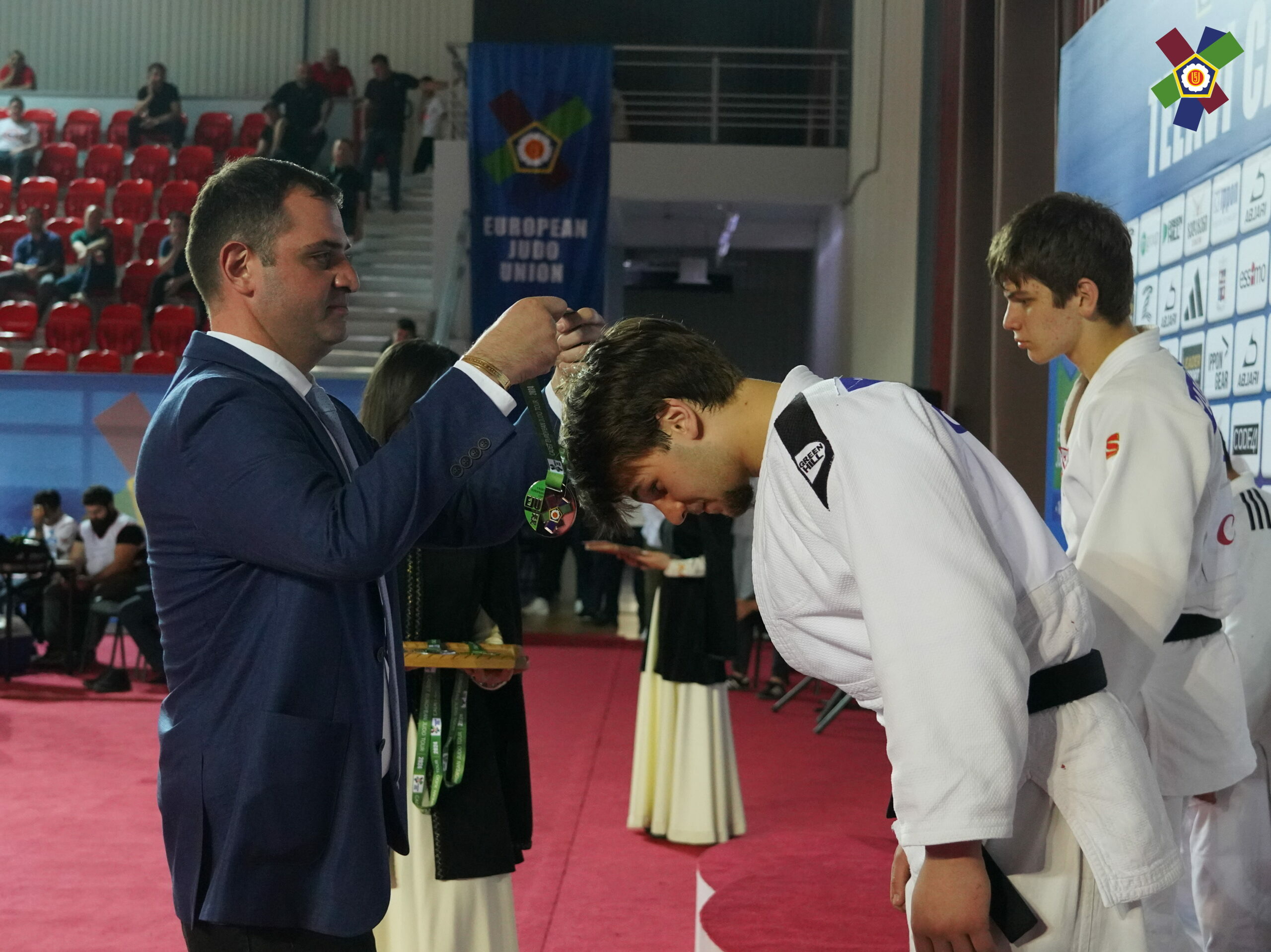
It was my first European Cup. There were eighteen athletes in my
category, and I was the only one with no previous European Cup
experience. I weighed around 78 kilograms, while some of my
opponents were entering competition day closer to 83 or 84. Only
months earlier, competing at that level had felt unimaginable.
In the final repechage round, I faced the Georgian national
champion - the same athlete who had defeated me in the
quarterfinal of the national championship after approximately
six minutes of golden score. This time, I beat him in under two
minutes.
But I injured my left elbow during the first seconds of the
fight. The pain became progressively worse during the break
before the final block. We used ice and tape, but neither helped
much. By the time I stepped onto the tatami for the bronze-medal
contest, I knew my arm was badly injured.
I still fought.
My opponent had reached the semifinal and given the eventual
champion a difficult fight. I defeated him in under a minute
with De-Ashi-Barai—one of the cleanest attacks I have ever
completed in competition. I had arrived at my first European Cup
as the least experienced athlete in the category and left with a
bronze medal.
After the award ceremony, the pain became so severe that I could
barely hold anything with my left arm. I could not train
properly throughout May.
I believed that the result would open another door. I waited for
an invitation to a national training camp or another opportunity
to prove myself internationally, but it never came. I kept
working throughout the summer, expecting that another chance
might eventually appear.
In September, I won silver at the Black Sea Cup. In November, I
travelled to the European Cup in Thessaloniki using my own money
because I needed more international experience. I lost in the
repechage and finished seventh. It was not the result I wanted,
but after the injuries and uncertainty surrounding that period,
it was still an important lesson.
After Greece, my rhythm began to disappear. I struggled to
return to the dojo consistently and spent much of December and
the beginning of January training alone. I gained weight and
moved from −81 kg to −90 kg.
My first competition in the new category was the second division
of the Georgian Senior Championship in February 2025. I won my
opening fight and then lost to the athlete who eventually became
champion. In the repechage, I was leading by waza-ari, but my
endurance in the new category failed me. I lost during the final
seconds.
I built my next plan around the Georgian Junior Championship. I
planned months of structured preparation, focusing on -
strength, technique, endurance and speed - and I genuinely
believed that I could reach the podium.
At the beginning of March, I injured my shoulder. On 4 of March,
the doctor told me that I should not train hard for one month
and prescribed medication that caused my body to retain
additional water. That evening, I went to the dojo to explain
the situation to my coach. There, I found out that the
championship had been moved from the beginning of June to 4 of
April - exactly one month away.
The month I needed to recover had become all the time I had left
to prepare.
I could not train at even half of my normal intensity. I took
the final dose of medication on the day of the weigh-in and had
to cut approximately six kilograms - the largest weight cut I
had ever attempted. I won my first fight in around thirty
seconds, but lost in the second round to an athlete who went on
to take bronze. It was his final year as a junior and it was my
first.
I later finished around seventh at the junior second division.
By then, however, the problems extended far beyond competition.
My weight was unstable. Injuries repeatedly interrupted
important preparation periods. My personal life was falling
apart, people around me were suggesting to stop, and I was
losing the spark I had already fought so many times to reignite.
August was probably the lowest point of my life. September and
October were not much better. I was trying to find a way forward
while quietly researching how I could move to Spain, but every
possible path seemed to create another problem.
Then, one Sunday morning in November, I woke up and made a
decision. I would prepare for the Georgian Senior Championship
harder than I had ever done for anything. If it worked, I would
continue from there. If it did not, I would put everything I had
into moving to Spain and beginning again.
I started the preparation weighing around 95 kilograms. I did
not have a perfect plan, but I committed to the process
completely. I built my diet and training structure as I went,
learning what my body needed through discipline, research and
daily adjustment. Over the following two months, I trained
harder than ever. My weight dropped, my speed returned and my
cardio felt strong. By competition day, 28th of December, I
weighed only 86 kilograms.
Then I lost the opening fight.
During an O-Uchi-Gari attack, my head collided with my opponent
and I felt as if I had been knocked down. We each scored yuko,
but after approximately three minutes of golden score, he scored
again. For the first time in around six years, my competition
ended in the first fight.
Two months of work seemed to collapse in seconds. I returned
home in complete shock. My brother had seen everything I had put
into the preparation. He asked me one simple question:
That was when I remembered the promise I had made to myself on
that Sunday morning.
At the time, I thought 2025 was taking everything away from me.
Looking back now, I see it differently. Every loss, injury,
delay and unanswered question was preparing me for what came
next. The year tested my belief, removed every comfortable
option and forced me to decide how much this journey truly meant
to me.
I am grateful for it now - not because it was easy, and not
because every part of it was fair, but because I believe God
used that period to build me. Without 2025, I might have never
found the courage to take the risk that changed my life.
That loss did not end my journey. It ended my waiting.